

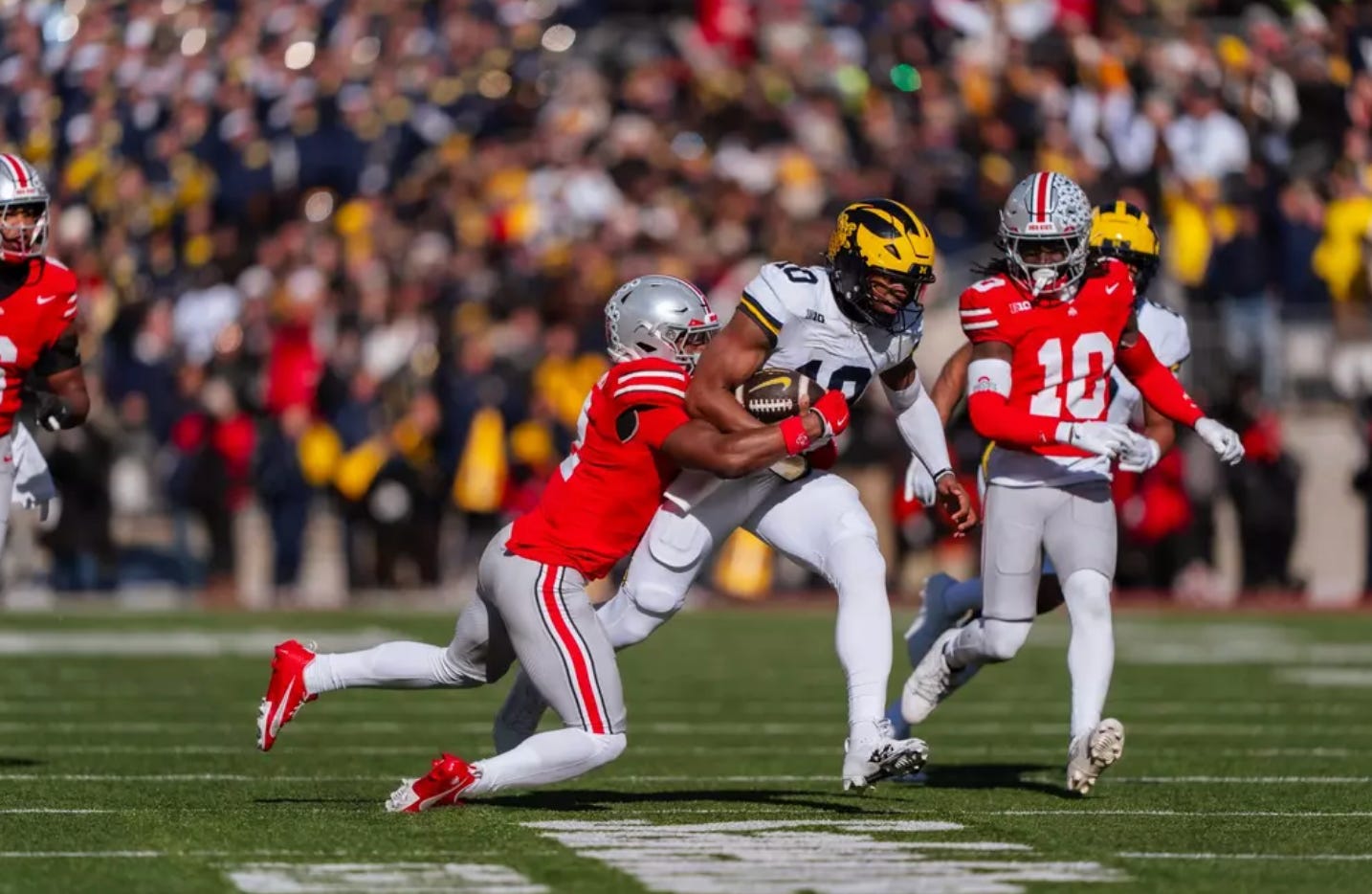
COLUMBUS — Ohio State’s 2024 national championship run came along with an endless stream of stories about the Buckeyes’ $20 million roster, the cost of winning a title in this new era of college football.
Turns out Michigan’s 2023 national championship will cost about the same.
The NCAA on Friday finally levied its punishments against the Michigan football program for multiple violations, described by as “an off-campus, in-person scouting scheme, impermissible recruiting inducements and communications, head coach responsibility rules, individuals' failures to cooperate and Michigan's failure to monitor.”
That’s a lot.
The punishment amounted to little.
The cost to Michigan? Four years of probation, various fines that will reportedly add to up to something between $20-30 million, toothless reductions of official visits this year, the addition of a one-game suspension for head coach Sherrone Moore (to be served in 2026) to the self-imposed two-game suspension that Moore will serve this year, and hefty show-cause penalties for people who were highly unlikely to ever work in college football again anyway, including former head coach Jim Harbaugh.
Translation: It was all worth it.
No vacated wins. No vacated title. No hammer.
I hope you weren’t waiting for any of that. As an Ohio State fan, the best thing you were going to get from any of this was the ability to say Michigan cheated its way to a national championship with your chest out. The NCAA gave you that. If you thought it was going to come with the death of the Michigan football program, or something severe enough to set the program back a few years, well, I’m sorry you were misled.
That’s not the world the NCAA lives in anymore, even if it acknowledged in its ruling that, in another era, it could have and likely would have crushed Michigan.
In its report, the NCAA said explicitly, “a postseason ban is required in this case.’ In fact, the report says that Michigan’s status as a “repeat violator” would warrant a multiple-year postseason ban. But the NCAA elected not to implement such a punishment because “a postseason ban would unfairly penalize student-athletes for the actions of coaches and staff who are no longer associated with the Michigan football program.”
For Ohio State fans, I can see how that admission would almost make things worse. We’re not that far removed from the 2012 Ohio State team having to pay for the sins of a previous regime.
Well, Dorothy, it’s not 2012 anymore.
If the NCAA tried to institute a postseason ban, Michigan would have sued it into oblivion, likely delaying the ban for a few years, and potentially overturning it entirely in the long run. The NCAA admitted that scholarship reductions, at another time, would’ve been appropriate. But that’s not how rosters are constructed in a revenue-sharing era.
I don’t think Michigan was conniving enough to know that the punishments for its improprieties would be rendered relatively harmless by the changing landscape of college football. It’s more that they just got lucky with the timing. Or maybe, in pursuit of a championship, it didn’t care either way. Nevertheless, the NCAA’s 74-page report amounts to, “Michigan did it. We’d like to do more. We really can’t. So here’s some spicy rhetoric,” because, quoting from the report, “aligning penalties with the current landscape required deviating in some areas.”
There’s such a thing as reputational damage, and Michigan suffers some here. No longer can the program hold itself up as the bastion of doing things above board, “the right way,” in pursuit of greatness. Harbaugh, the ultimate Michigan Man, has been branded a cheater by the NCAA in his efforts to resurrect his beloved program from the down years of Brady Hoke and Rich Rodriguez. His name appears 131 times in the report.
He’d probably disagree with the assertion, polish his national championship ring, and move on.
The “impact” on Michigan was always going to come from the court of public opinion, which had largely been shaped long before the NCAA said its piece on Friday. There was nothing so earth-shatteringly new in the report to sway people one way or the other.
You think Michigan cheated? You’re right.
You think it was no big deal? Well, the penalties certainly aren’t.
Whether or not Michigan did it was never in doubt, only the consequences. Michigan fans who were confident that their team would avoid the harshest possible punishments are now surely vindicated in some way because the program continues on with an ability to play for national championships this year and into the future.
Ohio State fans are largely left wanting more.
That outcome felt inevitable.
I went back in and linked the entire report, if anyone cares to read it
From the NCAA statement today:
“As a result of Michigan's most recent infractions case, three parties — Michigan, Harbaugh and Moore — fall within the legislated window to trigger repeat violator status. Michigan's repeat violator status, coupled with its Level I-Aggravated case classification, is sufficient grounds for a multiyear postseason ban. However, the panel determined that a postseason ban would unfairly penalize student-athletes for the actions of coaches and staff who are no longer associated with the Michigan football program. Thus, the panel determined a more appropriate penalty is an offsetting financial penalty instead of a two-year postseason ban.”
Lol well, there you have it folks… in the current NCAA, money is the only thing that matters. And if you are a big money school, you can get away with anything with a slap on the wrist. And for the first time in NCAA history, the “But won’t someone think of the children?!?” argument actually worked. What fucking joke.