

COLUMBUS — By all reports, the SEC is ready to move to a 16-team playoff, and it seems like a lot of college football is willing to go along with that.
The Big Ten is not ready.
That disagreement between the two conferences in charge of the future of the playoff has stalemated the sport at a 12-team playoff for 2026 again. It’s not that anyone necessarily wants to stay at 12, but the Big Ten and SEC can’t agree on what to do next.
I get where the Big Ten is coming from, based on two truths:
The Big Ten is the best conference in college football
The perception hasn’t caught up to that reality, especially when it comes to evaluating the second tier of those two conferences
It would be great if someone was looking out for the greater good of college football in any of these discussions. Absent a college football commissioner or centralized power that anyone respects, conferences end up fighting for themselves.
That’s why the Big Ten isn’t going along with 16. The numbers don’t add up.
In the two-year history of the 12-team playoff, the SEC has placed eight teams in the bracket, and the Big Ten has put in seven teams.
The SEC is 5-8 and hasn’t reach a national title game. Two of those wins are against each other, and one is against a G6 team. Two are against other power conferences.
The Big Ten is 11-5 and won both national titles. Two wins are against each and two are against G6 teams. Seven are against other power conferences.
Head-to-head, the Big Ten is 3-0 against the SEC the last two years in the playoff.
But let’s look at how many teams those two conferences would have put into the playoff the last two years in various structures.
Actual 12-team playoff: SEC 8, Big Ten 7
16-team playoff: SEC 13, Big Ten 7
16 teams with 4 auto bids for the SEC and Big Ten, 2 for the ACC and Big 12, 1 for the G6, and 3 at-larges: SEC 11, Big Ten 8
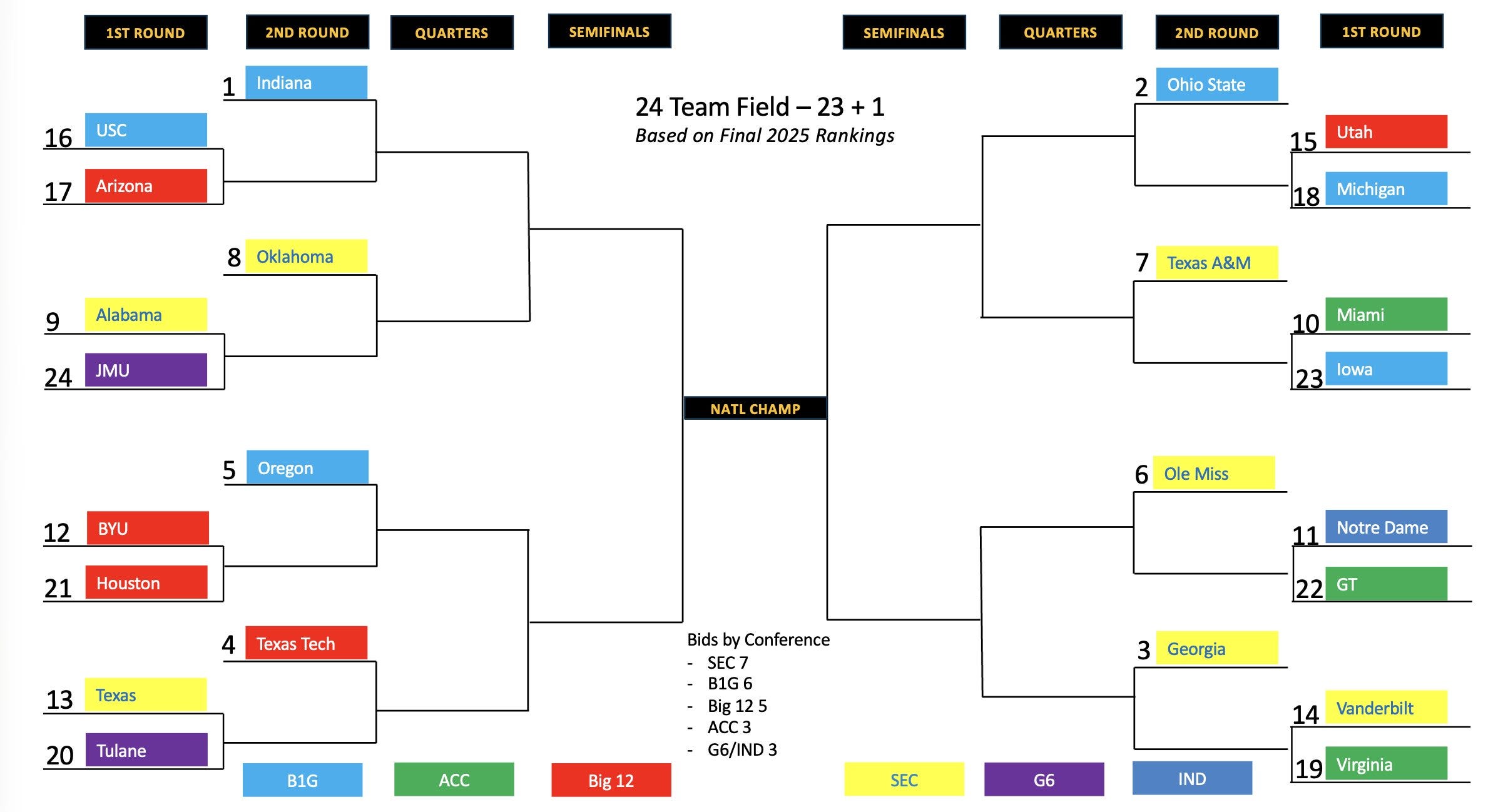
24-team playoff: SEC 14, Big Ten 11
As we know, the SEC has abandoned any notion that the top of its league is better than the Big Ten. But the SEC is now pushing a depth argument that much of college football is still buying.
Given the last two years, a move from 12 to 16 teams would do nothing for the Big Ten, while pushing into the playoff the next tier of SEC teams that don’t belong there.
Beyond the stark difference in actual playoff performance clearly showing the Big Ten’s supremacy at the top, bowl results show how the Big Ten depth is underrated compared to the SEC.
Bowl results aren’t everything. But they’re at least a little something.
After the 2024 season, 9-3 Illinois, ranked No. 20, beat 9-3 South Carolina, which was ranked 15th.
In a 16-team field, South Carolina would have made it. Illinois would not have. (Also in 2024, unranked Michigan beat the No. 11 Alabama team the entire SEC was angry didn’t make the playoff.)
After the 2025 season, 8-4 Iowa, ranked No. 23, beat 10-2 Vanderbilt, ranked No. 14.
In a 16-team field, Vanderbilt would have made it. Iowa would not have.
Overall this postseason, the SEC went 4-10. The Big Ten went 11-5.
SO WHY SHOULD THE BIG TEN AGREE TO ANY PLAYOFF STRUCTURE THAT GIVES THE SEC EVEN MORE TEAMS, WHILE ADDING NOTHING TO THE BIG TEN?
That, in my opinion, is why the Big Ten and commissioner Tony Petitti previously presented a 16-team plan with four automatic qualifiers for the Big Ten and SEC, two each for the ACC and Big 12, and one for the Group of Six.
No one seemed to like that.
So now, as reported by ESPN, the Big Ten floated a new specific 24-team bracket idea.
Why? Because the Big Ten, by playoff performance, recent national titles, and overall bowl performance this year, is the best conference in college football.
But the playoff committee, and the national consensus, still leans toward the SEC when it comes ranking teams in the teens.
So until that perception changes — and it should based on what has happened on the field — the Big Ten isn’t going for 16.
Either stick at 12, where both middles are left out …
Go to 16 with automatic qualifiers, so some degree of Big Ten and SEC equality is mandated …
Or go to 24 when both middles will get in.
In those three scenarios, the SEC still would have had an (unearned) edge the last two years. But it wouldn’t be almost double the number of playoff teams for the SEC compared to the Big Ten, like it would be in a 16-team bracket, which over 2024 and 2025 would have been 13 to 7.
We talked about all of this, and more, in our latest video and podcast.
I’m not trying to convince anyone that a 24-team playoff field is definitely the way to go. But I’m glad the Big Ten is fighting for itself.
Apple Pods:
Spotify:
Great article and discussion. I think 24 is a bit much. I think 16 is too but if it were capped at say no more than 4 teams per conference that could help the perception that the SEC only wants it so it could get 7 teams in, I'd be for it. Definite yes to eliminating conference champions. Have co-champs if they have identical records and didn't go head to head in regular season, If they did winner of that game is the champ.
I like Bill's idea of only scheduling a year or two out to avoid the Indiana situation. Although to completely make fair and balanced schedules, while preserving rivalry games, would probably be a nightmare.
In the end $$$ will probably win out and we'll all just continue to root for the Bucks.
This 24 team playoff is bad. Would I still watch, yes, because I love college football. Who cares who the "best" conference is by whatever you as an individual want to define. A 24 team playoff is just commissioners, presidents, AD's and suchlike filling their pockets and trying to increase their job security. 12 isn't perfect and they are never going backwards, so 8 (which I think would be right) isn't going to happen. Don't make it worse by adding more teams to try and "fix" what you created. I'd rather have fewer games with the most on the line rather than more games that are watered down.