

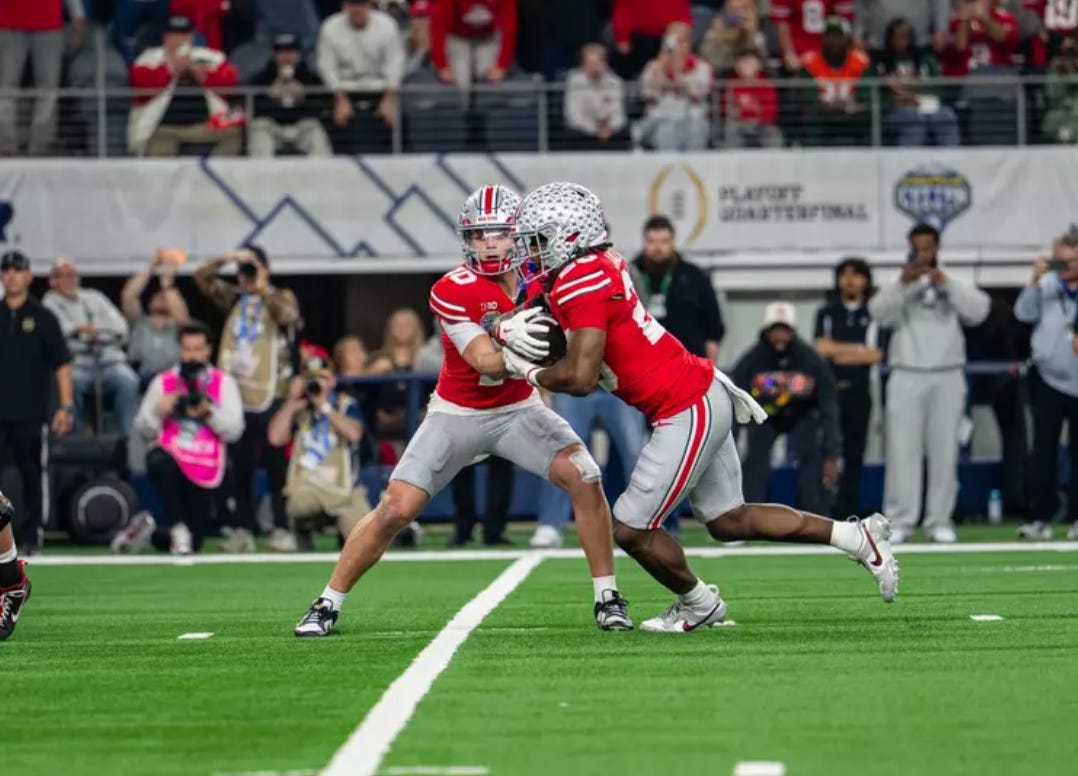
COLUMBUS — Trailing 14-0 at halftime of its College Football Playoff quarterfinal loss to Miami last year, Ohio State ran a total of 22 plays on its first two drives of the second half as it tried to fight its way back into the game. On those 22 plays, the Buckeyes snapped the ball with fewer than 10 seconds on the play clock 12 times.
There was no urgency, just the same painstakingly slow style that OSU had played with all year. By the end of it all, the team finished with the second-slowest pace in the country by seconds per play. Only Army played slower.
Prior to its losses against Indiana and Miami in the final two games of the season, the negative consequences of playing so slow hadn’t bitten the Buckeyes. Until then, their plan to “control” games and strive for efficiency over everything else was, for all intents and purposes, working, just as it had the year before when they won the national championship. When you’re up a few scores on outmatched teams, playing at a slow offensive pace makes an opponent feel like its in the vice of a boa constrictor. They feel like they never have the ball enough to get back into the game. For 12 games, Ohio State’s choice to dole out slow deaths was difficult to argue with.
That comfort led to an ill-fated comment from head coach Ryan Day during his radio show last November when he was asked about his team’s lack of tempo.
“Efficiency is what we’re after,” Day said. “That’s how you control the game. When it’s time to turn up the gas, we will.”
If there was ever a time to turn up the gas, it was last Dec. 31 against Miami in the Cotton Bowl. Aside from an end-of-first-half two-minute drill, the Buckeyes never picked up the pace. Needing to chip into a two-score deficit, OSU had only three possessions in the second half. Miami, with the lead, was happy to play so. Why the Buckeyes responded in kind from the trail position remains baffling. The game became the poster event for a recent ESPN article about the slowing pace of play in college football.
There’s been an ongoing conversation about Ohio State’s strategic decision to play so slow ever since that Miami game. You could sense Day’s increasing frustration with the topic throughout the offseason, but it will remain a talking point until his offense shows its better equipped to change speeds when necessary. With the 2026 season opening on Saturday against Ball State, this is a foundational question for Day’s offense.